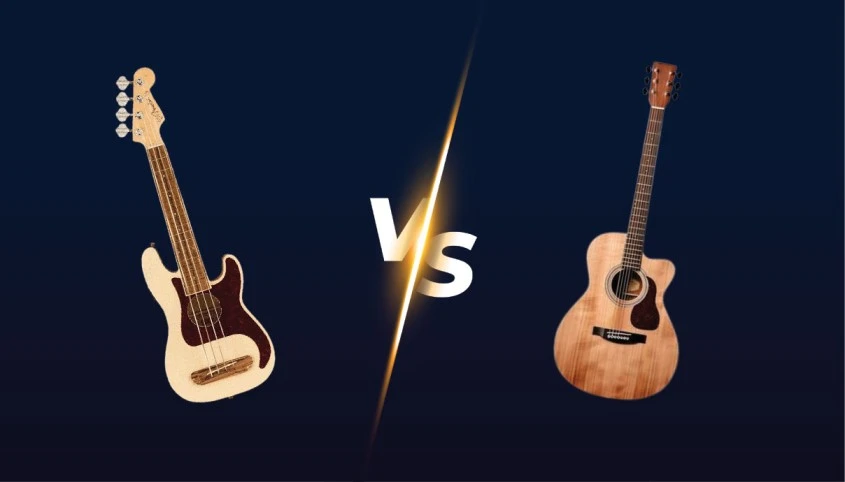
If you’re deciding between an acoustic vs bass guitar, the biggest difference is their role in music. An acoustic guitar is commonly used for chords, strumming, melody, and accompanying vocals, while a bass guitar provides low-frequency rhythm, groove, and harmonic support within a song.
Both instruments can be great choices for beginners, but they offer very different playing experiences. Your favorite music, whether you want to play alone or with a band, and the type of lessons you want to take can all help determine which instrument is right for you.
In this guide, we’ll compare acoustic and bass guitars and help you choose based on your musical goals.
Acoustic vs Bass Guitar at a Glance
| Feature | Acoustic Guitar | Bass Guitar |
|---|---|---|
| Main role | Chords, rhythm, melody, and accompaniment | Rhythm, groove, and low-end foundation |
| Typical strings | 6 | 4 on most standard basses |
| Sound | Brighter, higher-pitched | Deeper, lower-pitched |
| Playing style | Strumming, chords, picking, finger style | Fingerstyle, picking, and baselines |
| Common use | Solo playing, songwriting, accompaniment | Bands, rhythm sections, and ensembles |
| Amplifier | Not required | Usually needed for full volume |
| Portability | Simple to carry and play | Portable, but usually requires an amp |
| Beginner focus | Chords, rhythm, and melodies | Timing, rhythm, and individual notes |
Neither instrument is universally better. The right choice depends on what you want to play.
What Is an Acoustic Guitar?
An acoustic guitar produces its sound naturally through the vibration of its strings and the resonance of its hollow body. You don’t need an amplifier to hear it, which makes it a practical instrument for home practice, songwriting, and playing with friends.
Acoustic guitar is particularly useful for:
- Chord-based playing
- Strumming
- Fingerstyle playing
- Singing while playing
- Songwriting
- Solo performances
If you want to pick up an instrument and play a song without setting up additional equipment, an acoustic guitar offers a simple starting point.
If you’re also deciding between acoustic and electric guitar, our guide to Acoustic Guitar vs Electric Guitar: Making the Right Choice? explores that comparison in more detail.
What Is a Bass Guitar?
A bass guitar looks similar to a guitar, but its job in music is different. A standard four-string bass is tuned E-A-D-G, an octave below the corresponding lowest four strings of a standard guitar. Its lower range gives music depth and connects closely with the rhythm and harmony of a song.
Bass players commonly focus on:
- Basslines
- Rhythm
- Groove
- Timing
- Supporting chords and harmony
- Playing with drums and other musicians
A bass doesn’t usually replace the role of a guitar. Instead, the two instruments can complement each other in a band.
That’s why bass can be especially appealing if you enjoy listening for the rhythm and low-end part of a song rather than the guitar chords or melody.
7 Differences Between Acoustic and Bass Guitar
1. Sound and Pitch
The most noticeable difference is their range.
An acoustic guitar produces higher-pitched notes that work well for chords, melodies, and accompaniment. A bass guitar is designed for much lower frequencies, giving a song weight and helping establish its rhythmic and harmonic foundation.
If you want an instrument that can provide a complete chordal accompaniment on its own, acoustic guitar is usually more suitable.
If you love the deep sound underneath a song and want to build baselines around the rhythm, bass may be more appealing.
2. Strings and Neck
A standard acoustic guitar usually has six strings. A standard bass guitar usually has four, although five- and six-string basses are also available.
The fewer strings on a bass don’t necessarily make it physically easier.
Bass strings are thicker, and bass necks are generally longer. The wider spacing and longer scale can feel different, especially for a beginner.
So don’t assume that four strings automatically means an easier instrument.
3. Playing Technique
Acoustic guitar often introduces beginners to:
- Open chords
- Strumming
- Picking
- Fingerstyle
- Chord changes
Bass generally focuses more on individual notes and lines rather than playing full chords.
Beginners may start by learning simple baselines that follow the underlying harmony and rhythm of a song. As they progress, they develop techniques such as finger style playing, picking, muting, and more advanced rhythmic patterns.
This means the two instruments develop different skills even though they belong to the same instrument family.
4. Role in Music
This is one of the most important differences to understand.
An acoustic guitarist can play chords, rhythm, melodies, and accompaniment. The instrument can work well on its own.
Bass usually works as part of a larger musical arrangement. It often connects the drums and rhythm with the harmonic structure of the song. Fender similarly describes bass as having a distinct role within a band and emphasizes its relationship with rhythm and harmony.
Think of it this way:
Acoustic guitar: “I want to play the song.”
Bass: “I want to help make the song groove.”
Both roles are important, but they appeal to different types of players.
5. Equipment
One practical difference is the equipment required.
With an acoustic guitar, you can simply tune the instrument and start playing.
With an electric bass, you’ll normally need:
- Bass guitar
- Amplifier
- Cable
- Tuner
You can hear an unplugged electric bass, but it is much quieter than an acoustic guitar and isn’t designed to provide its full performance volume without amplification.
This makes acoustic guitar simpler if you want a minimal setup.
6. Musical Styles
Both instruments appear across many genres, but they often have different roles.
Acoustic guitar is common in:
- Folk
- Pop
- Country
- Singer-songwriter music
- Indie
- Blues
Bass is commonly heard in:
- Rock
- Funk
- Jazz
- Pop
- Blues
- Metal
These aren’t strict categories. Both instruments can be used across a much wider range of music.
The most useful question is not “Which genres belong to each instrument?” but rather:
Which part of the music do you enjoy most?
7. Playing With Other Musicians
Acoustic guitar can work very well when you’re playing alone. You can sing, play chords, and create a complete accompaniment without needing another musician.
Bass has a different strength: playing with others.
A baseline can lock in with the drummer and support the harmonic movement of the song. This makes bass particularly appealing to people who enjoy playing in bands or being part of an ensemble.
If the idea of rehearsing with other musicians excites you, bass may be worth considering.
Is Bass Easier Than Acoustic Guitar for Beginners?
Bass can feel easier at first because beginners often play one note at a time instead of forming full guitar chords, but it isn’t universally easier to learn.
On acoustic guitar, beginners often have to coordinate several fingers to form chords and then change between those shapes while maintaining a steady rhythm.
Bass can allow a beginner to play simple lines with fewer notes. However, bass has its own challenges, including thicker strings, a longer neck, and the need for accurate timing and note length.
So the better question is:
Which type of challenge do you enjoy more?
If you want to learn chords and strumming, acoustic guitar may feel more natural.
If you enjoy rhythm, groove, and playing along with a drummer, bass may be a better fit.
Which Guitar Should You Choose?
The answer becomes easier when you start with your goals.
Choose Acoustic Guitar If You Want To…
Sing while playing
Acoustic guitar is a natural choice for accompanying your voice with chords.
Write songs
You can use chords, rhythm, and melody to develop a complete song idea on one instrument.
Play by yourself
An acoustic guitar can provide rhythm, harmony, and melody without needing a band.
Learn popular songs
Many popular songs can be adapted for acoustic guitar using relatively simple chord progressions.
Take your instrument anywhere
You don’t need an amplifier to hear an acoustic guitar, making it convenient for casual playing and practice.
Choose Bass Guitar If You Want To…
Play in a band
Bass is designed to work as part of a larger musical arrangement.
Focus on rhythm and groove
If you naturally pay attention to the baseline and drums when listening to music, bass may be a particularly good match.
Build baselines
Instead of primarily playing chord shapes, you’ll learn how individual notes work with the song’s harmony and rhythm.
Explore funk, rock, jazz, or similar styles
These genres can offer plenty of opportunities to develop bass-focused playing.
Work closely with a drummer
The relationship between bass and drums is a major part of the groove in many styles of music.
What If You’re Also Considering Classical Guitar?
If you’re interested in acoustic guitar but prefer a softer, nylon-string sound, classical guitar is another option worth understanding.
Our guide to Classical Guitar vs Acoustic Guitar: Which One Should You Choose? explains the differences between these two instruments and can help you decide which type of guitar fits your goals.
The important thing is not to choose an instrument simply because it is considered the “standard” beginner option. Choose based on the music you actually want to play.
Which Guitar Lessons Match Your Goals?
Choosing the right instrument is only the beginning. The right lessons can help you develop good technique, understand rhythm, and build a practice routine that matches your goals.
If you want to learn chords, strumming, songwriting, or accompany your voice, Guitar Lessons in North Vancouver can help you develop the skills needed to become a confident guitarist.
If bass is the instrument that attracts you, a teacher can help you develop timing, rhythm, baselines, and the techniques needed to play effectively with other musicians.
You don’t need to know exactly what level you’re at before starting. An instructor can help you identify your starting point and build your learning path from there.
Frequently Asked Questions
Can I learn bass without learning acoustic guitar first?
Yes. You do not need to learn acoustic guitar before starting bass. The two instruments share some musical concepts, but bass has its own techniques and playing approach.
Should I learn acoustic guitar before bass?
Not necessarily. If your main goal is to play baselines, develop groove, or join a band, you can start directly with bass.
Learning acoustic guitar first can still be useful if you’re interested in chords, songwriting, or understanding the guitar side of an arrangement.
Is bass guitar good for beginners?
Yes. Bass can be a good beginner instrument, especially for students who enjoy rhythm, groove, and playing with other musicians.
However, its longer neck and thicker strings can present physical challenges, so choosing an appropriately sized instrument is important.
Do I need an amplifier for bass?
If you’re using an electric bass, an amplifier is normally needed to hear it at useful performance volume. You can hear the strings acoustically to some extent, but this is much quieter than an amplified bass.
Is acoustic guitar or bass better for a child?
There isn’t one answer for every child.
Consider the child’s age, physical size, musical interests, and what kind of music they enjoy. A child who loves singing and playing songs may connect with acoustic guitar, while a child fascinated by rhythm and bands may prefer bass.
Can learning acoustic guitar help with bass?
Yes. Guitar can introduce skills such as rhythm, notes, chords, and fret board awareness that can be useful when learning bass.
However, bass has its own physical technique and musical role, so guitar experience doesn’t replace learning how to play bass.
Can I play acoustic guitar songs on bass?
You can play the notes and baselines from many songs originally played on acoustic guitar, but the experience will be different. Bass generally focuses on supporting the harmony and rhythm rather than reproducing the guitar’s chordal accompaniment.
“Should I start with bass or guitar?”
This usually comes down to what you want to do with the instrument.
If you want to play songs by yourself, sing, and use chords, acoustic guitar is a natural starting point. If you want to play with a band and enjoy rhythm and groove, bass may be the better match.
“Is bass easier than guitar?”
Bass can be easier to start in some situations because simple baselines often use individual notes instead of complex chord shapes. But that doesn’t make bass an easy version of guitar.
Bass requires strong timing, rhythm, muting, and control. Experienced players can find both instruments challenging in different ways.
“Do I need to know guitar before learning bass?”
No. You can start directly with bass.
Some guitar knowledge can help, but it isn’t a prerequisite. If bass is the instrument you are genuinely interested in, starting with bass can be a perfectly reasonable choice.
“Why does bass have fewer strings but feel bigger?”
A standard bass has fewer strings than a guitar, but those strings are thicker and the neck is longer. The instrument is designed to produce much lower notes, which requires a different physical design.
“Is bass boring if I play alone?”
Bass can certainly be practiced alone, but its musical role is often most obvious when you hear it with drums, guitar, or other instruments.
If you enjoy playing complete songs by yourself, acoustic guitar may provide a more immediately self-contained experience.
Conclusion: Acoustic or Bass Guitar?
The choice between acoustic and bass guitar comes down to the kind of musician you want to become.
Choose acoustic guitar if you want to play chords, sing while playing, write songs, practice independently, or take your instrument almost anywhere.
Choose bass guitar if you enjoy rhythm and groove, want to play with other musicians, or are drawn to the low-end part of songs.
Neither instrument is simply “better” or universally easier. They serve different musical purposes and develop different skills.
The best first instrument is the one that matches your interests closely enough that you want to keep playing it.
Once you’ve made your choice, professional guidance can help you build the right technique and practice habits from the beginning. Whether your goal is to become a guitarist or explore the role of bass in a band, starting with the instrument you genuinely enjoy is a strong first step.